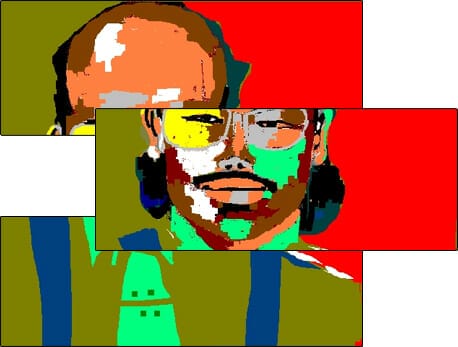

Viet Tran On Wheelchair
English Version by ChatGPT and proofread by T.Vấn from the Original in Vietnamese: T.Vấn: Nhạc phẩm TAI BIẾN và chàng nghệ sĩ trên chiếc xe lăn
1.
Musician Trần Lê Việt, known for his iconic prison song often recalled and replayed every year around April 30th—Black April (or most memorably, April: 29 Days and 31 Nights)—celebrated his 72nd birthday by “receiving” a wheelchair and slowly moving toward the end of life’s road. The once free-spirited man with his guitar can no longer wander, even though the guitar still sits by his side, still a source of joy for him in every moment not consumed by illness.
Earlier, upon hearing that writer Huy Phương was preparing to publish his (final) work The Final Station while battling illness, Trần Lê Việt, deeply moved, wrote: “These days, many of our brothers and friends are departing one by one. Seeing the book The Final Station by Huy Phương made me want to jot down a few lines.”
THE FINAL STATION
For Huy Phương
To Oanh Vấn, Yến Phi, Hòa Sự, Ánh Tiến, Vân Chí,
And my old friends
Then we too must leave, why linger still?
The whistle calls farewell, a moment shrill
Life’s train rolls onward to its final place
What luggage do we take in such a race?
What luggage do we carry through the night?
A hand to gently brush away the blight
A wisp of smoke dissolved into the breeze
A prayer, a bell, some fragile memories
We leave behind our joys, regrets, and years
The loves, the angers, laughter, aching tears
Our scarves and coats are now but fleeting dreams
Our beds and pillows drifting cloudlike streams
We leave behind this ache we cannot name
The solemn oaths, the joys, the loss, the flame
Now one departs, the other waits in vain
A station bathed in tears, alone again
Trần Lê Việt, never one with a “poet’s blood,” didn’t intend this piece to be a proper poem—it was the lyrical draft for a song yet to be born.
Unfortunately, before the melody could fully take shape—or perhaps just as it had—one of the arteries in his brain “suddenly burst,” forcing him to be airlifted for emergency treatment, followed by weeks of rehabilitation. His left leg and arm refused to respond to his mind’s commands.
From that point on, the wheelchair became Trần Lê Việt’s close companion—alongside a keyboard (replacing his beloved guitar, which his left hand could no longer manage) and a stack of staff paper.
(The poem The Final Station was eventually turned into a song, Lonely Life Station.)
2.
Over the decades, I’ve accompanied Trần Lê Việt on every journey—from everyday life to cultural and artistic endeavors. When I retired, I decided to leave the city where our two families had lived side by side since our first children were born until they had grown and left the nest. I left behind many things that had, by chance or fate, bound the two of us together since that fateful April 30, 1975.
We shared the same initial for our surnames (Trần, Trương), the same initial for our first names (Việt, Vấn), the same age (72), the same military rank by war’s end (First Lieutenant), and the same role within our units (Head of the Arts Performance Team). For nearly ten years in prison, we shared the literal weight of the same pair of handcuffs as we were transferred from camp to camp—from South to North, and North back to South.
Once, during a prisoner transfer by train, our wrists were shackled together with a single iron cuff. Still, we managed—Trần Lê Việt strumming a makeshift guitar, me singing hoarsely to welcome the South with the song The Twilight Train. (At the end, I changed “twilight” to “heading South” for added dramatic flair.)
All the windows were ordered shut, so that cigarettes and snacks tossed in from bystanders could not reach us, and so that the prisoners’ letters, written in advance, could not be thrown out to the crowd in hopes of being mailed to our families. The compartment was dark, save for the occasional flashlight of patrolling guards. But the music went on.
A guard once shone his flashlight on our handcuffs—two thin wrists bound together, one still playing, one still singing—and muttered, “Even in chains, you guys still manage to perform music?”
After our release, we shared the struggles of daily survival in a Saigon no longer the Saigon of old—not the one the musician had kept alive in his heart and music during long nights in prison.
At one point, Trần Lê Việt and I even took on the role of “Phở Vendor Võ Đại Lang” at the once-famous Choeng Nam restaurant on Hai Bà Trưng Street, right behind the old National Assembly building (now the City Opera House). The restaurant became a meeting place for former prison mates to reconnect, to rest after long days chasing scraps of livelihood in the new Saigon.
And so it was no surprise that we ended up rebuilding our lives together on foreign soil—in the city of Wichita, Kansas, USA. There, we each had two children (two with the surname Trần, two Trương). They grew up together, supported each other, and, like their fathers, became closer than kin.
3.
It seems fate has bound me and Trần Lê Việt together with some strange, invisible, yet miraculous thread. We both carry within us an intense artistic passion, living wholly with that “artist’s soul” forged in our youth. Once more—perhaps for the last time—we are walking side by side through the literary website T.Vấn & Friends.
In 2007, Trần Lê Việt released his first music collection after many years of quiet labor: Fifteen Love Songs – The Warhorse Song. I was the one who wrote the foreword and introduction. Several songs in that album we had sung together back in prison. And there were many more “shared things” like that.
The website T.Vấn & Friends was always the first to present his new CDs: Love Songs, The Stranger, Faded Life… His prison songs were featured prominently in the Prison Ballads section, which we curated alongside fellow former prisoners like Nguyễn Tiến Việt, Trọng Minh, artist Trần Thanh Châu, and YouTuber Nguyễn Văn Ngoan.
Without TLV’s early encouragement and help, I might never have had the courage to launch that project.
4.
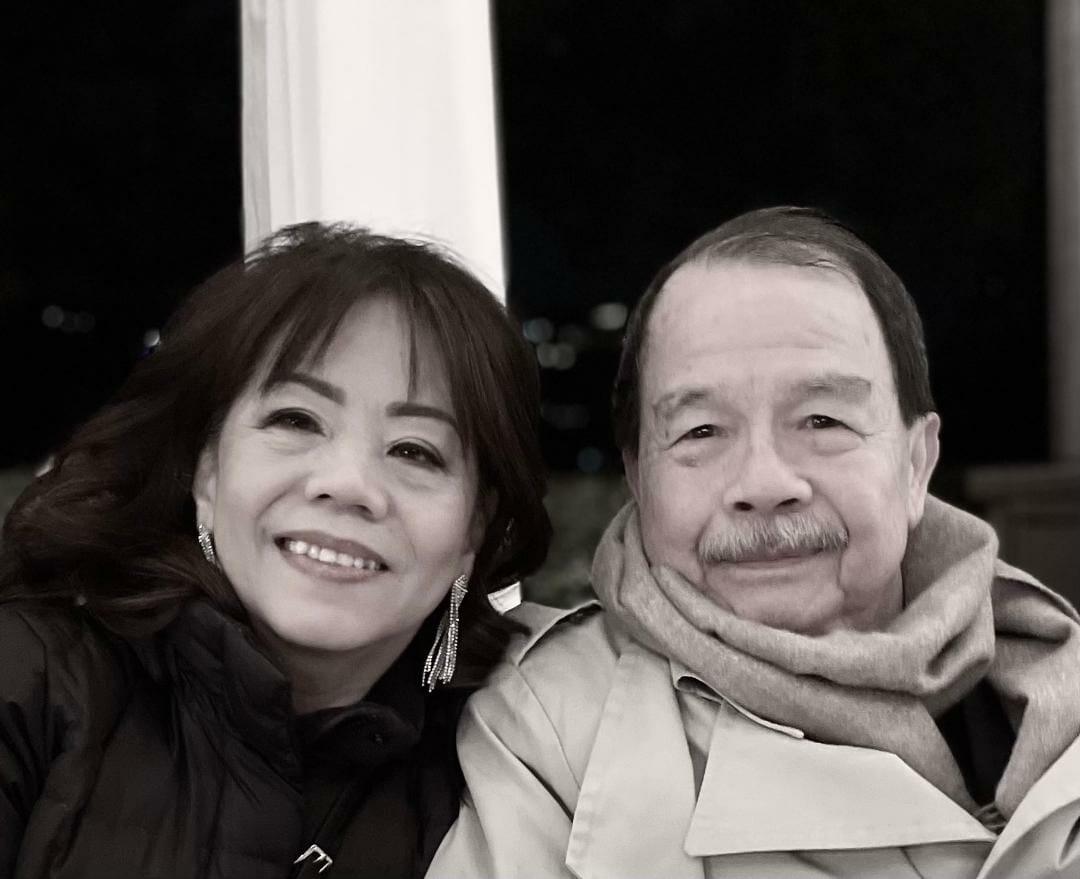
NS/Trần Lê Việt and his wife
Years passed. We celebrated joint birthdays together—120 years (60 each), 140 years (70 each)—surrounded by our families and children. Nearly fifty years ago, we could never have imagined such moments while toiling side by side as a two-man work team, cutting bamboo in the mosquito-infested forests of Yên Bái, our faces swollen, our bodies scratched by sharp bamboo like knives. We looked at each other, weary and hopeless.
Illness and age have nearly rendered one of us “disabled.” But once again, I am awed by my friend’s unbreakable spirit, his refusal to surrender to fate.
Since suffering a stroke in November 2021, which left his left side paralyzed, TLV has doggedly rehabilitated. A few months later, he could walk again—though his left arm seemed lost to him forever.
Yet his music continued to flow, richer and more profound, even if created with only one “pecking” hand on the keyboard. Over the past two years, the T.Vấn & Friends site has proudly presented his new compositions: Farewell, The Way Home, Lonely Life Station, and May I Be Your Shadow. These works are astonishing creations—born from what should have been a terminal stroke.
And now comes his most raw, most personal, most unvarnished song yet: STROKE.
It began with a poem by Ngọc Phi—a dear friend from prison days—written upon seeing TLV confined in his cruel wheelchair:
A Sad Love Song
(A Heart’s Song for My Beloved)
You never knew such sorrow would arrive—
The day you’d lose the strength to hold me close
To guide me gently in a tender dance
To look into my eyes with silent love
You never knew the darkness lying ahead—
Like a statue, cold and lost in thought
Unable even to watch me quietly
Push your wheelchair into your last horizon
You never knew there’d come a day
You couldn’t wipe away my falling tears
Oh! Your hand, now lifeless and numb
Like a dead leaf in autumn’s mourning garden
You never knew the night of the stroke
Would wither your body beneath the moon
In sorrow your soul would sink so low
My love—where now is happiness?
(For Trần Lê Việt – Ngọc Phi, May 2023)
And then:
I thought my tears had all run dry
But found them still, the tears of men
Alone in night’s vast emptiness
I weep for you—your joy, now dying.
And thus, the song STROKE was born:
I never knew a day this sad would come
A day I couldn’t stand beside you
Couldn’t guide your steps to music’s rhythm
Or gaze into your gentle, tender eyes
I never knew a day this sad would come
A statue now, brooding and alone
Behind your quiet, wordless wheelchair push
You strain to pull me up life’s final slope
Who could have known one day I’d lose the power
To wipe the tears that welled in your soft eyes
Oh, my hand—so numb, so cold, so still
Like rotting wood in autumn’s desolate garden
Who could have known the stroke would come one night
A tragedy descending on my life
A grief that shattered your happiness
And drowned us both in muted sorrow
I thought my tears had long since dried
A man’s tears gone, a distant past
But in this lonely, drifting night
I feel them fall—for your fading life
(STROKE – Trần Lê Việt)

The song is a message of love and gratitude to the wife who came into his life nearly forty years ago, during a time of hardship and displacement. And now, once again, she is faithfully by his side, just as she was in those early fragile days, after nearly forty years of sharing both joys and sorrows.
And so, the tears of a steadfast man silently fall in the lonely darkness—not for his own broken body, but for the wife who has devoted her entire life to her husband and children. A quintessential Vietnamese woman, though she has lived abroad for thirty years.
Even the title of the song—TAI BIẾN (Stroke)—reflects TLV’s creative mind and sharp sensitivity as a composer. In terms of melody, TAI BIẾN marks a great leap forward from TLV’s pre-wheelchair compositions. His post-wheelchair musical journey reveals a different world—deeper, more contemplative, and richer in imagery. For example:
Behind the wheelchair, you silently and quietly
Struggle to push me over life’s final slope.
The sound—through the singer’s voice and the accompaniment—pulls the listener upward, as if climbing that last hill of life. The image is beautiful, romantic, and deeply poignant. At the same time, TAI BIẾN is a hymn to the Vietnamese woman, embodied in the figure of the beloved wife of the composer.
To express so much in such a short piece of music—can we still see this old composer in a wheelchair as “disabled” in the usual sense of the word?
Another beautiful aspect worth mentioning is the empathy of a young friend we came to know through her lyrical essays on Đà Lạt, published on T.Vấn & Bạn Hữu. Upon hearing the song for the first time, she said, “It’s beautiful, but so sad.” And yet she understands, perhaps more than anyone, that truly great music is rarely cheerful. It’s a kind of sorrow elevated by the musician’s hand—placing high and low notes into a unique arrangement, breathing life into them so they may soar through a sky now existing only in the memories of the one in the wheelchair. And so, the sadness in TLV’s music is transformed by the artistic soul of the young friend into profoundly human and haunting images in a video clip of the same name.
Most striking are the vast blue skies and the natural beauty of Đà Lạt’s forests and mountains, which seem to affirm with the composer that although our bodies may age and weaken, the wings of art and music still have the strength to carry us across the heavens like drifting clouds. And with love, with the unwavering loyalty of the life partner walking behind the wheelchair, the composer will journey to the ends of the earth—an affirmation that LOVE IS STRONGER THAN DEATH.

(Video clip TAI BIẾN, produced by NTN)
5.
Whether Trần Lê Việt will go on to compose more after TAI BIẾN, only time will tell. But for now, with the birth of this song—born from the harshness of fate—we wish to mark nearly fifty years of walking together side by side. From the wartime days amidst the sound of bombs, to the cold hunger of forced labor camps, from the daily struggles to make ends meet to the soaring moments of artistic creation—through it all, we are still lucky enough to sit beside each other today and share the bittersweet wine of life. Whether our hands tremble, our eyes blur, or our legs falter (or can no longer move at all), it no longer matters. We have lived a life worth living. And we still dearly love this mad, beautiful world. Even if life hasn’t always been kind to us.
Like today, when my friend must bind himself to a wheelchair, waiting for his wife to push him up life’s final slope.
And we are grateful for the beautiful message from our young friend, NTN, through the image of the sun still shining bright behind a curtain of rain and whitened skies. Even if we had only one more day to live, we would still look toward that future day, in the radiant glow of the sun.
— T.Vấn
